Switching to Leanbase? Great choice! This quick guide will walk you through the essential steps to migrate seamlessly to Leanbase.
In this guide, you'll find:
Key differences between Leanbase and Googlesheet
How to seamlessly migrate your Googlesheet data to Leanbase
#How Leanbase different from Googlesheet
In this guide, you'll find:
Key differences between Leanbase and Googlesheet
How to seamlessly migrate your Googlesheet data to Leanbase
How Leanbase different from Googlesheet
-
Status and Section: Leanbase uses both status and section:
-
Status in Leanbase:
In Leanbase, users have three main status categories: Not Started, In Progress, and Done. They can add new statuses within these categories, specific to each board.
To reuse a custom status set, users must save it as a Settings Pack.
-
Section in Leanbase:
Users can create unlimited sections in which each capable of storing tasks with different statuses.
To streamline workflows, users can assign a specific status to a section. When a status is set for a section, all tasks with that status will automatically be organized into that section.
-
-
Task level:
Leanbase offers three task levels: Module → Task → Subtask, with Module being the highest level, representing an epic, milestone, or feature.
-
Custom field:
In Leanbase, custom fields are linked to task types, with each task type having its own set of custom fields. To reuse a task type and its custom fields, users can save them as a Setting Pack. Custom fields can also be reused across the entire workspace.
Settings pack add-on features: A Leanbase Setting Pack includes Task Types with Custom Fields, Automations, Labels, and Statuses. Users can create, assign, or unassign Setting Packs to different boards, enabling them to reuse board configurations and streamline workflows across the entire workspace.
How to Import from Googlesheet into Leanbase
How to Export a Googlesheet as a CSV File
Open the Google Sheet: Navigate to the Google Sheet you want to export.
Access the File Menu: In the top-left corner, click on File.
Choose Download Option: From the dropdown menu, hover over Download.
-
Select CSV Format
-
Click on Comma-separated values (.csv, current sheet).
Note: This exports only the currently active sheet.
-
Download the File
Try the Leanbase Import Tool
Leanbase offers a new, streamlined tool for importing data from Googlesheet boards into Leanbase quickly
Click the hamburger menu icon located on the right-hand side of the screen to open board settings
Select import tasks button
In the Import tasks section, drag the CSV file you wanted to import or click the Select CSV file to import
Upload the Googlesheet CSV file
Important note:
Step 1: Move all members to Leanbase boards
Before importing, ensure all users from your old boards are added to Leanbase to prevent tasks from being unassigned.
Step 2: Rearrange Googlesheet CSV to map the to Leanbase Boards
Field Customization Options:
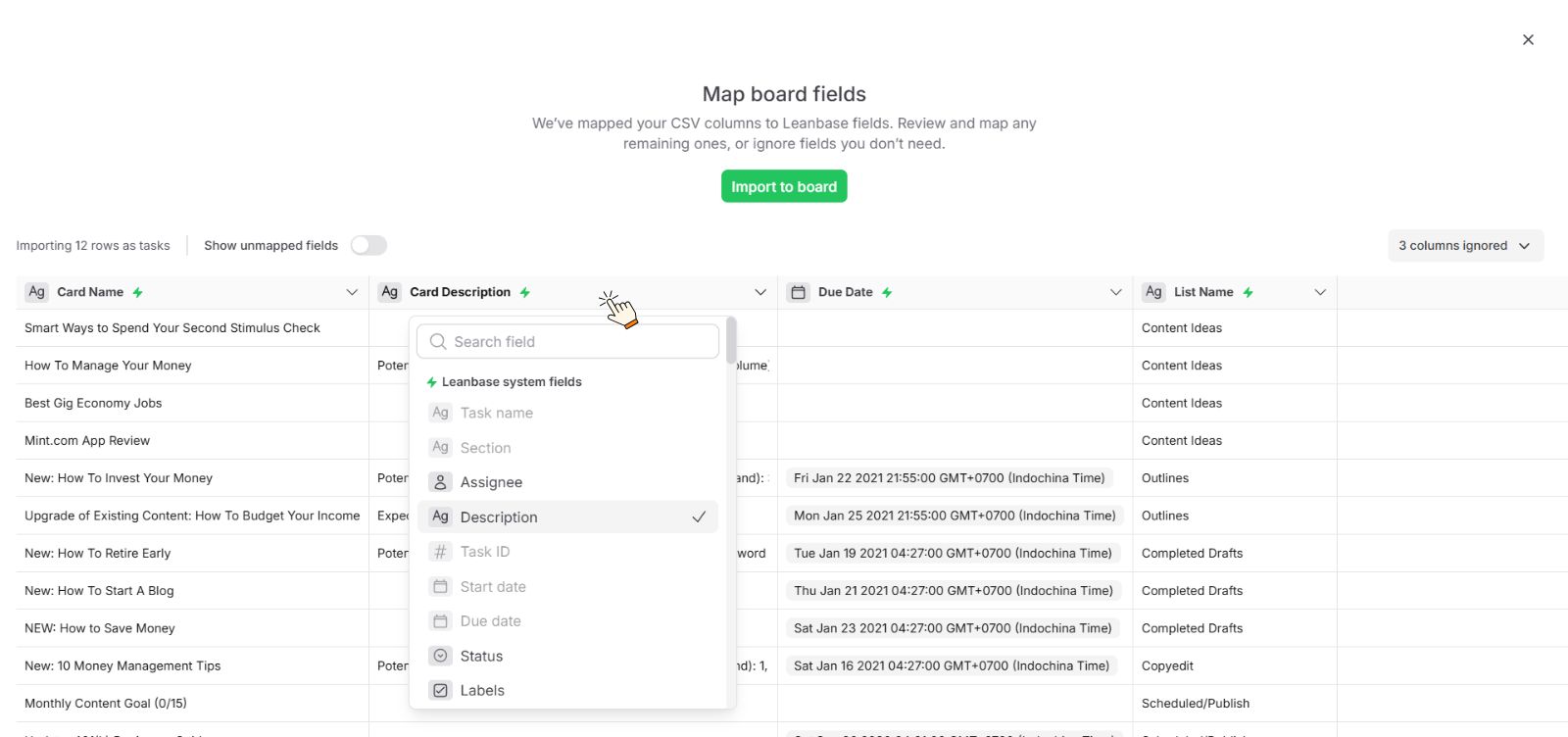
Select a Leanbase system field as the default for tasks or other Leanbase fields.
Search for existing fields in your workspace or create a new custom field to match.
Choose to ignore fields that are not relevant.
Pro Tip:
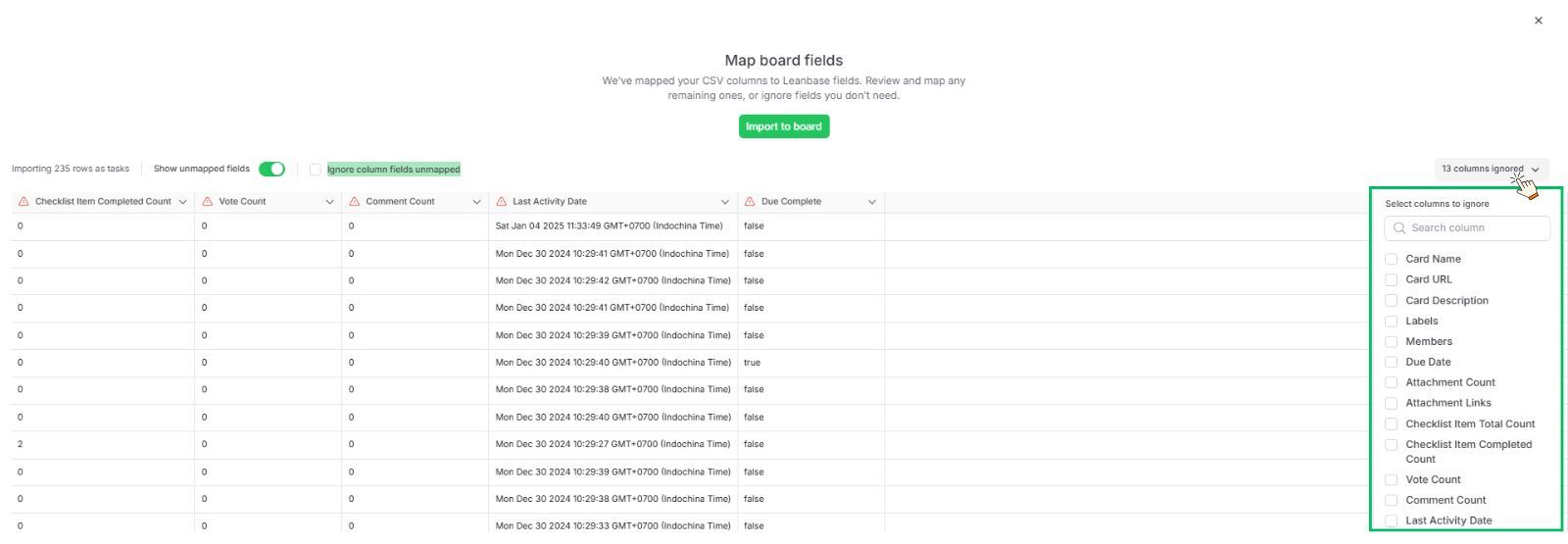
Enable Show Unmapped Fields to display only unmatched fields for easier review.
Use the Ignore column fields unmapped button to skip unnecessary fields and speed up the import process, avoiding time spent on irrelevant data.
-
Users should double-check the data mapping to ensure the correct information is imported accurately.
Required Columns for Leanbase CSV
To import tasks succesfully, you must fill in required fields to map the Leanbase fields.
-
Task Name
Fill in the task names from your CSV Googlesheet data.
-
Section
Specify the section where you want to store each task.
-
Task type
-
Specify the task type for each task, such as Module, Task, User Story, or Subtask.
Module: The highest level, representing an epic or a feature.
Subtask: The lowest level, representing detailed, specific work items linked to a parent task.
Module contains tasks and tasks contains subtask
-
-
Status
Specify the status of each task. You can rearrange and customize the status types after importing them successfully.
-
Assignee
Add the name or email of the assignee as they appear in Leanbase.
-
Description
Copy over or create descriptions for your tasks.
-
Task ID
Leave this blank or skip if you don’t have task IDs.
-
Labels
Add relevant labels to categorize or identify tasks.
-
Parent_ID
For subtasks, add a Parent Task ID to link them.
Example: If creating subtasks, assign a unique ID to the parent task in the Task ID field and reference it here.
-
Due Date
Format dates as m/dd/yyyy h:mm:ss PM/AM.
Example: 9/20/2024 6:27:00 PM.
Leanbase CSV format:
Tips
Ensure consistency in Assignee names or emails to avoid import errors.
Use a unique ID for Parent and Task ID fields when linking tasks.
Validate your CSV format before importing to Leanbase to avoid errors.
-
Field Ignore Management:
Leanbase allows you to manage ignored fields during the import process effectively, user can select Show more button to unhide those ignored fields:
Ignore Specific Fields: Select individual fields that you don’t want to import and mark them as ignored.
Ignore All Fields: Quickly bypass all unmatched or irrelevant fields using the Ignore All Fields option on Unmapped Fields