Users getting value: Measuring activation with Leanbase
Tracking Activation in Leanbase
You should have the basics of your Leanbase integration up and running by now.
Next, you’ll need to define and track the behavior that shows a user is truly gaining value from your product.
This is called activation — the point when a user experiences your product’s core value and becomes likely to return, engage, and progress further.
If a user never reaches activation, they probably haven’t yet understood your product’s value and may not come back.
Just like your North Star Metric, activation should be seen as a leading indicator of revenue.
Ask yourself: What actions must a user take to realize your product’s value and eventually become a paying customer?
A sign-up or login alone doesn’t equal activation — those are surface-level events. Measuring activation helps you uncover whether users are truly engaging and how product design influences that engagement.
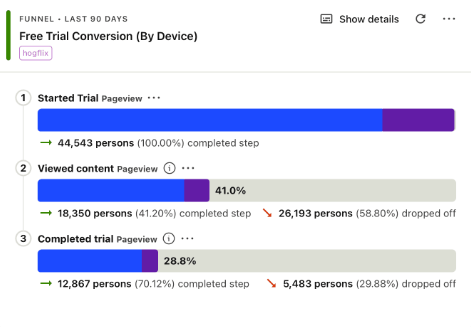 Once your product emits the right events, you can visualize and measure activation using a Funnel Insight in Leanbase.
Funnels show how users progress from general activity (e.g., “Signed up”) to your defined activation event (e.g., “Completed setup”).
You’ll see conversion rates between each step and identify where users drop off. Each funnel step can be filtered by user property, segment, or event detail to reflect your exact activation logic.
Example:
For an imaginary streaming service called Leanflix, the funnel might include:
started_trialviewed_contentcompleted_trial
The final event, completed_trial, represents activation — the point when a user experiences the full value of the service.
Learn more in our Funnels documentation.
Once your funnel is set up, add it to your project dashboard alongside other key insights such as those tracking your North Star Metric.
Activation by Example
Let’s look at how different products define activation:
Dropbox: A user who stores one file within their first week is considered activated. Experiencing seamless syncing demonstrates real value.
Uber: Activation happens when a user takes their first ride — once they see how easy it is, they’re likely to do it again.
Pinterest: Activation is based on usage frequency — if someone uses the product more than four days in a month, they’re activated.
Leanbase Session Replay (example): Activation could be defined as a user who’s watched at least five replays. Viewing just one or two is more like testing, not adoption.
Every product has a unique activation moment. It can be a single event, a combination of actions, or a threshold of activity.
Planning Activation
Think about activation for your own product:
What events or actions represent a user truly understanding your product’s value?
Which events already tracked in Leanbase correspond to this behavior?
Do you need to instrument additional events to capture it accurately?
Advanced Activation Tracking
If your activation journey involves multiple possible paths — for example, several different actions could count as activation — you can use a custom query in Leanbase.
Custom queries let you define flexible activation logic and measure conversion across multiple event types or user behaviors.
For deeper guidance, check out our article on finding your activation metric, where we explain how to identify and validate the behaviors that predict long-term engagement.
Next Steps
Now that your events are flowing into Leanbase and your activation metric is defined, the next step is to understand retention — how many of those activated users continue to come back and use your product over time.