What is a NPS and NPS Impact Score?
Keeping customers happy isn’t just good service—it’s what drives growth. That’s where NPS (Net Promoter Score) comes in. It shows you how loyal your customers are and how likely they are to recommend you. But loyalty alone isn’t the full story.
The NPS Impact Score digs deeper, showing which experiences are boosting satisfaction and which ones are holding it back. Together, they help you see what really matters to your customers and where to focus for the biggest impact.
How can we leverage this NPS Impact Score?
You can use the NPS Impact Score as a decision-making tool to understand why your NPS is trending up or down, and where to act. Here are some practical ways:
Identify key drivers → See which factors have the biggest positive or negative influence on overall NPS health.
Prioritize improvements → Focus resources on the drivers with the largest negative scores since they’re pulling NPS down the most.
Spot strengths → Recognize the drivers with large positive scores to double down on what’s already working well.
Track changes over time → Monitor how impact scores shift as you roll out new features, fixes, or processes.
Segment insights → Compare impact scores across different user groups (e.g., by region, platform, customer tier) to uncover patterns.
👉 Essentially, it helps you move from just knowing your NPS score to understanding what’s behind it and how to improve it.
Since the impact score is derived from NPS, let’s first understand what NPS is to gain deeper insight into the value of the NPS Impact Score.
What is a NPS?
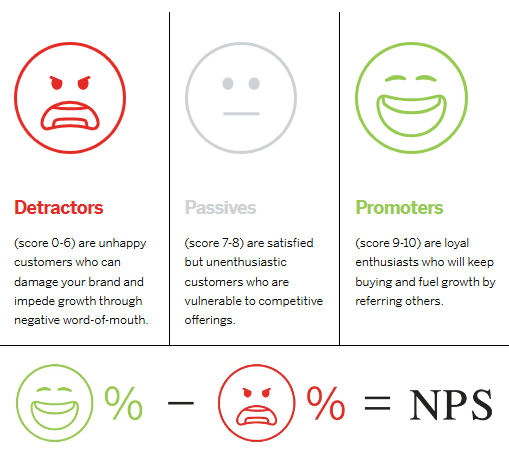
NPS stands for Net Promoter Score, which is a common metric used in customer experience programs. An NPS score measures customer loyalty by looking at their likelihood of recommending a given business.
How do you calculate Net Promoter Score?
It’s simple to calculate your final NPS score – just subtract the percentage of Detractors from the percentage of Promoters.
For example, if 20% of respondents are Detractors, 20% are Passives and 70% are Promoters, your NPS score would be 70-20 = 50.
 What’s a good Net Promoter Score?
As we discuss in our article on setting NPS goals, Bain & Company recommends the following scoring framework:
Above 0: Good
Above 20: Favorable
Above 50: Excellent
Above 80: World-class
So, should you aim for “world-class”? The answer is both yes and no. While it’s tempting to think that only scores near 100 are truly impressive, there isn’t a universal “good” NPS. What counts as strong performance depends heavily on the benchmarks within your specific industry.
What is an NPS Impact Score?
In addition, an NPS Impact Score quantifies how a specific issue or theme affects a company's overall Net Promoter Score (NPS), revealing the identify drivers of positive and negative sentiment and their influence on the NPS score.
What is the NPS Impact Formula:
The NPS Impact Score is calculated by this formula:
NPS Impact = NPS(All topics) - NPS(Records Without Field)
What’s a good Net Promoter Score?
As discussed, we suggest you following this framwork score
Above 0: Positive drivers to NPS Overall Score Health
Equal to 0: Neutral drivers to NPS Overall Score Health
Under 0: Negative drivers to NPS Overall Score Health
Note: A negative NPS Impact Score is normal—it simply highlights areas where your product needs improvement and gives your team clear issues to focus on.
FAQs:
1. Q: What is a negative NPS Impact Score mean?
A: A negative impact score shows that this topic or factor is dragging down your overall NPS health. The more negative the score, the stronger its contribution to customer dissatisfaction and lower loyalty.
2. Q: What is a positive NPS Impact Score mean?
A: A positive impact score indicates that this topic or factor is lifting your overall NPS health. The higher the score, the more it contributes to customer satisfaction and loyalty.
3. Q: Is it normal to see a negative impact score?
A: Yes, it’s completely normal. A negative NPS Impact Score doesn’t mean failure—it simply points out areas where your product is creating friction, so your team knows what to improve.
4. Q: What should I do if my NPS Impact Score is negative and close to 0?
A: An NPS Impact Score close to 0 indicates that the factor has minimal influence on overall NPS health. This may be because the factor itself has little impact, or because the impact is diluted across many topics, making each contribution small. In such cases, prioritize the topic with the most negative score—even if all scores are close to 0.